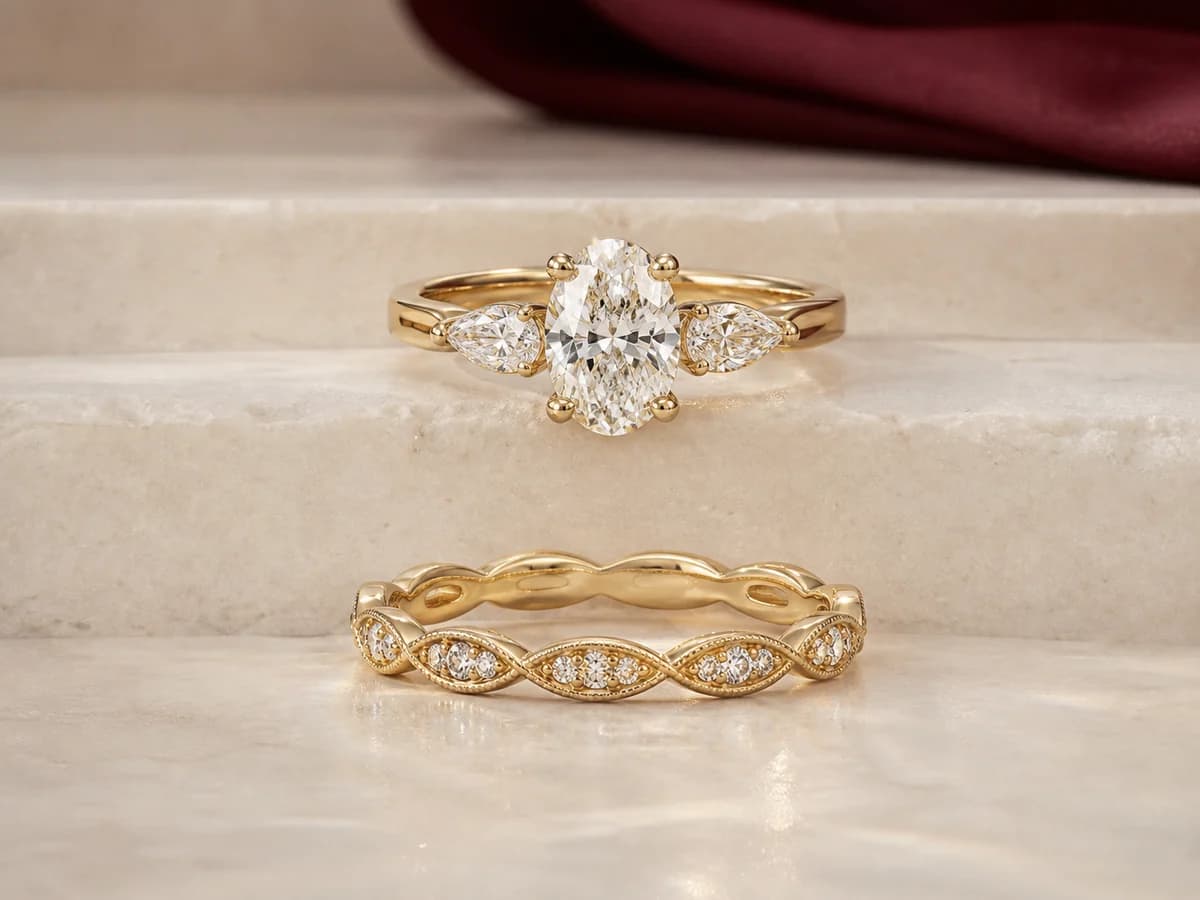
Pair a wedding band with the actual engagement ring, not the style name alone. Review top, side, and on-hand views; check setting projection, gap or contact, total width, movement, comfort, material and finish interaction, and access for cleaning before deciding.
A whole-pair method for choosing a wedding band from the actual engagement ring, intended finger, total width, gap or contact, movement, comfort, materials, settings, and care questions.
What this guide covers
- Document the engagement ring's size, profile, setting, stones, and projecting details.
- Compare straight, curved, contour, or open directions in the complete pair.
- Try the rings together and record fit, gap, contact, movement, care, and open construction questions.
Start with the complete pair
Engagement-ring profile
Record size, shank, bridge, gallery, head, setting height, center outline, prongs, accent stones, and details that project.
Band geometry
Compare straight, curved, contour, open, guard, or custom-fit directions without assuming a named style will sit flush.
On-hand fit
Review knuckle passage, base fit, total width, ring order, movement, gap, contact, and ordinary-condition comfort.
Wear and care
Ask how materials, finishes, settings, edges, debris, cleaning access, inspection, and future service affect the pair.
Pair the rings in a useful order
- 1 — Bring the actual engagement ring
Use the intended finger and current size; photographs and model names cannot show the full profile or fit.
- 2 — Compare more than one geometry
View straight, shaped, or open options from top, side, underside, and on the hand.
- 3 — Check the complete stack
Move the hand and review width, gap, contact, orientation, edges, setting clearance, comfort, and cleaning access.
- 4 — Record the exact pairing
Document size, order, viewed spacing, materials, finish, stones, settings, and unresolved construction or care questions.
A close fit is not a permanent promise
Scope
Ring orientation, finger condition, size, finish, setting, wear, repair, and movement can change spacing and contact. This guide does not guarantee flush fit, comfort, no wear, stone security, resizability, or future compatibility.
Wedding-band pairing questions
Must the rings sit flush?
No. A gap or close fit is a style and geometry choice. Review the actual pair for comfort, contact, movement, and care.
Can a photo identify the right curve?
Not reliably. The exact ring profile, size, setting projection, orientation, and tolerance for space need measured or physical review.
Will matching metal prevent wear?
Not necessarily. Alloy, finish, stone edges, debris, contact, movement, and condition all affect the complete pair.