A thoughtful choice between two sizes
Let the band, knuckle, and daily comfort guide an in-between size.
When two readings seem plausible, keep both instead of forcing an early answer. Leyloon can review the intended band and how the ring needs to pass the knuckle.
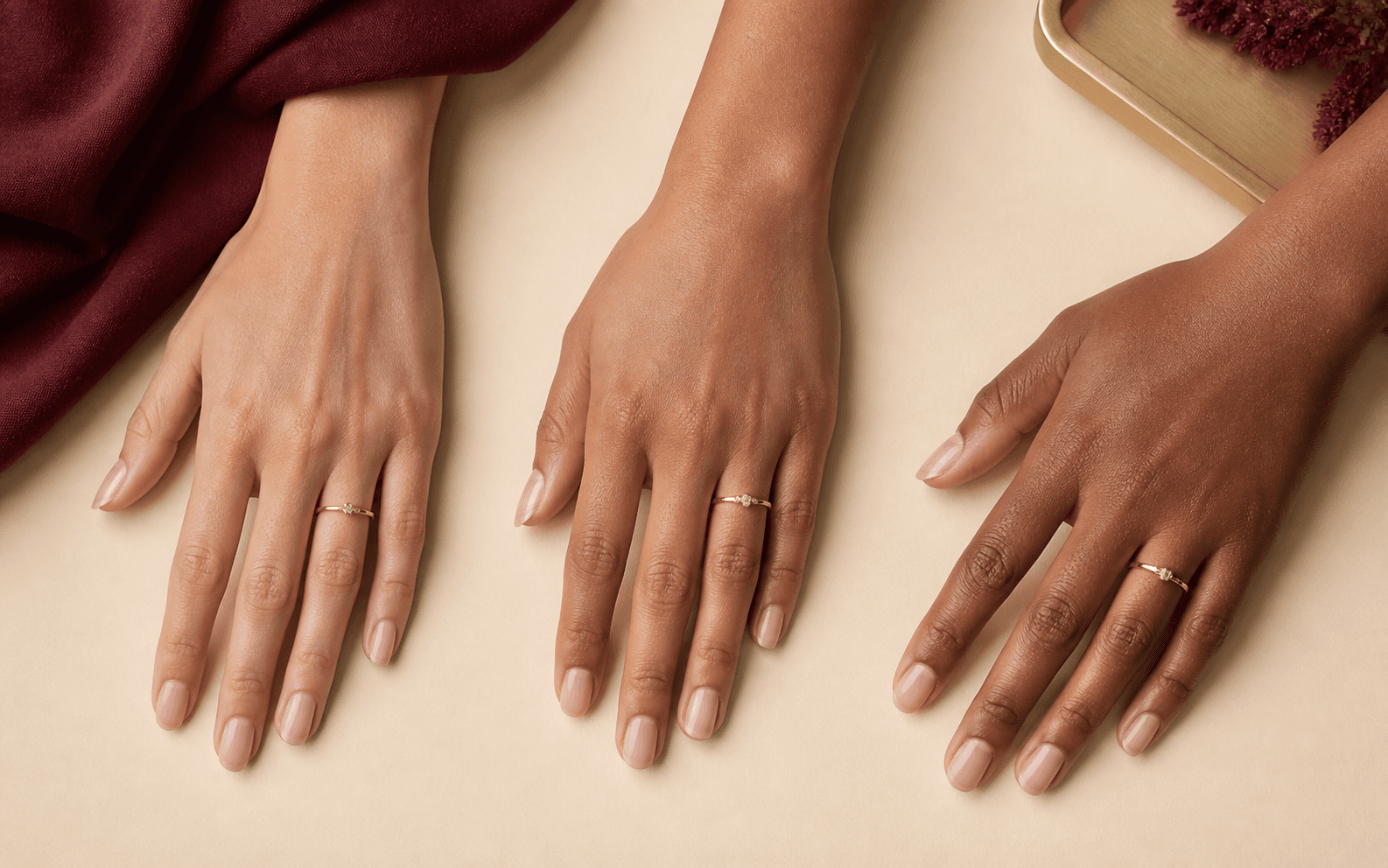
Fit, wear & care—considered together
A clearer decision, with the important context kept beside it
Keep both nearby sizes visible. The better direction depends on passage, resting comfort, band width, interior profile, and ordinary fit changes.
Use this page when
- Repeated readings fall around two nearby sizes in the table.
- Two physical gauges feel different but neither is an obvious answer.
Pause and choose another path when
- You plan to round up without testing the exact band width.
- The finger is currently injured or unusually swollen.
Where this choice often matters
- Choosing between two sizes for a wedding band.
- Reviewing a custom ring that may be hard to resize later.
Compare the details
Compare both candidates instead of hiding one
Keep both candidates and the tradeoff between them visible for Leyloon review; there is no universal rule to round up.
| Test | Smaller candidate | Larger candidate | Decision note |
|---|---|---|---|
| Knuckle | More resistance | Easier passage | Never force |
| Finger base | Less movement | More rotation | Observe ordinary wear |
| Wide band | May feel tighter | May add room | Use similar width |
| Temperature range | Check ordinary warm moment | Check ordinary cool moment | Avoid extremes |
Ring-size reference chart
Compare named sizes with inside measurements
Keep your original system and maker’s chart. This table is a comparison aid, not a universal fit promise.
| US & Canada | UK, Europe & Australia | Asia | Inside diameter | Inside circumference |
|---|---|---|---|---|
| 3 | F | 4 | 14.1 mm | 44.3 mm |
| 3.5 | G | — | 14.5 mm | 45.6 mm |
| 4 | H | 7 | 14.9 mm | 46.8 mm |
| 4.5 | I | 8 | 15.3 mm | 48.1 mm |
| 5 | J | 9 | 15.7 mm | 49.3 mm |
| 5.5 | K | 10 | 16.1 mm | 50.6 mm |
| 6 | L | 11 | 16.5 mm | 51.8 mm |
| 6.5 | M | 13 | 16.9 mm | 53.1 mm |
| 7 | N | 14 | 17.3 mm | 54.3 mm |
| 7.5 | O | 15 | 17.7 mm | 55.6 mm |
| 8 | P | 16 | 18.1 mm | 56.9 mm |
| 8.5 | Q | 17 | 18.5 mm | 58.1 mm |
| 9 | R | 18 | 19.0 mm | 59.7 mm |
| 9.5 | S | 19 | 19.4 mm | 60.9 mm |
| 10 | T | 20 | 19.8 mm | 62.2 mm |
| 10.5 | U | 22 | 20.2 mm | 63.5 mm |
| 11 | V | 23 | 20.6 mm | 64.7 mm |
| 11.5 | W | 24 | 21.0 mm | 66.0 mm |
| 12 | X | 25 | 21.4 mm | 67.2 mm |
| 12.5 | Y | 26 | 21.8 mm | 68.5 mm |
| 13 | Z.5 | 27 | 22.2 mm | 69.7 mm |
| 13.5 | Z1 | — | 22.6 mm | 71.0 mm |
Reviewed 2026-08-25. Source reference: GIA ring-size guide. This table follows GIA’s US and Canada, UK/Europe/Australia, and Asia columns; blank cells are not listed by GIA. Leyloon uses the nearest physical row without interpolation and keeps your original measurement beside it.
Questions worth asking
Open the concern that sounds like yours
Choose the question that sounds like yours. Each answer keeps the next step clear without closing decisions that still need review.
Is it safer to go larger?
Not always. A larger ring can spin or slip, while a smaller one can be uncomfortable at the knuckle.
Can an interior profile change the choice?
Yes, so keep the exact profile and width with both candidates.
Can I request a quote before choosing?
Keep both fit directions in the design request; final making details still need review.
Ready when you are
Carry this direction into your design
Leyloon can keep these choices together while you continue. Every detail stays editable. Your choices stay editable as you continue.
- Both candidate sizes and original systemNeeded before the direction is complete
- Exact width or stackA useful next question
- Interior profileKeep it open if you are still deciding
- Knuckle, rotation, and ordinary variationKeep it open if you are still deciding
A visual map of this brief
See what stays known—and what remains open
This guide begins with “Keep both readings until the band and knuckle explain the better fit.” The next choices stay grouped, editable, and connected to that same Atelier brief.
- Ring you are sizingChoose the ring context so the measurement stays attached to the right width, profile, and finger.
- What measurement do you have?Keep the method with the number. The working tool above can help compare it without replacing the maker's final fit check.
- Band width or stackChoose the planned contact width. Exact millimeters stay editable.
- What could change the fit?Choose the closest context. You can add the exact measurements privately in Atelier.
Start with what matters on this page
Keep the measurement with the ring it belongs to
Choose how you measured and the ring context. Keep the intended finger, method, width, and fit notes together; review your profile visibility before sharing saved details.Published customer proof
Real experiences, kept separate from promises
Only approved purchase-linked reviews appear here. An illustrative scene is never presented as a customer, and one person’s experience is never treated as a promise for another piece.See what Leyloon customers have shared
Read recent shop reviews on Etsy, then come back when you are ready to shape your own fit and jewelry direction.
These reviews reflect individual Leyloon service experiences. Your fit and jewelry direction and quote request are reviewed on their own.