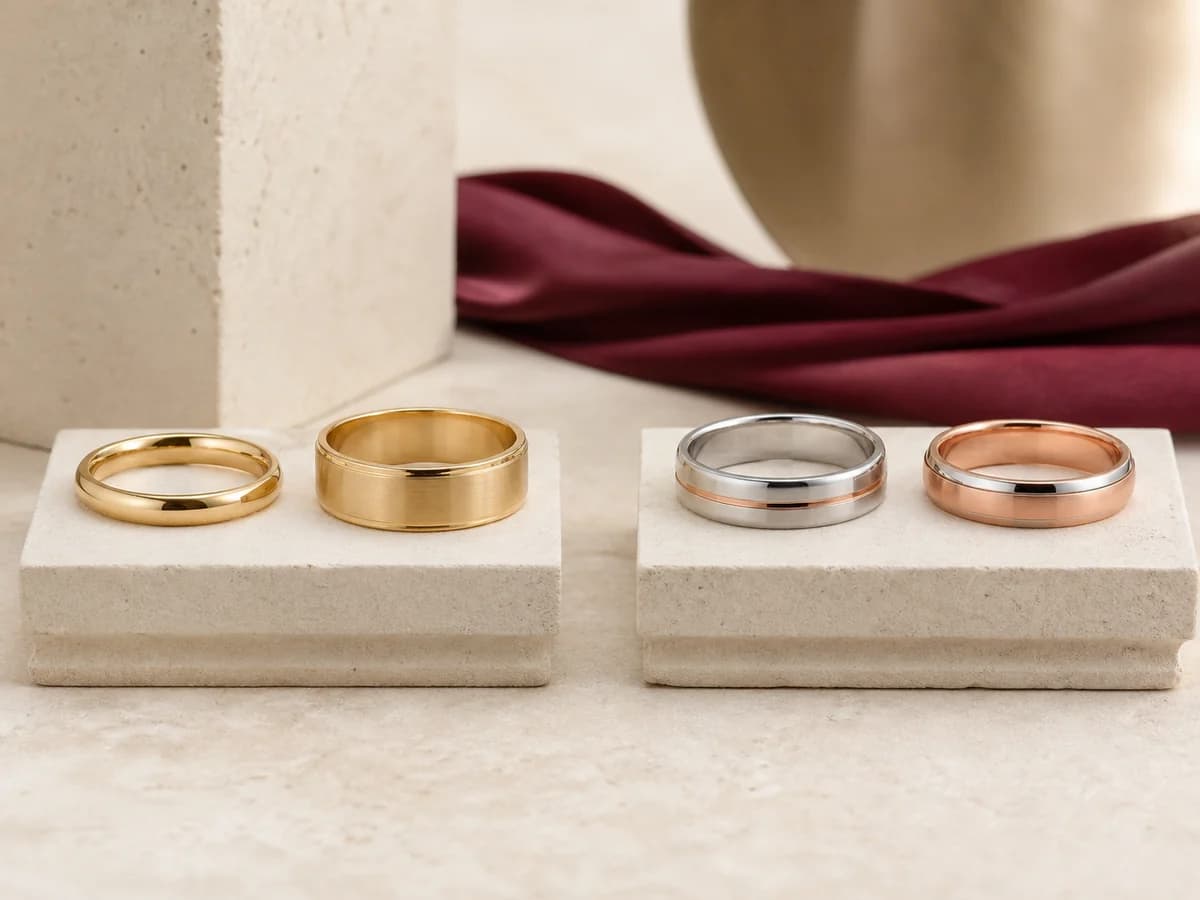
Matching wedding rings can repeat material and design details; mixed-metal rings can use contrast or let each wearer choose independently. Neither approach is more meaningful or durable by default. Verify each exact alloy, finish, fit, setting, maintenance need, and contact relationship.
A neutral comparison of matching and mixed-metal wedding rings across shared design language, individual fit, exact alloy and finish disclosure, maintenance, contact wear, and personal preference.
What this guide covers
- Define matching as shared attributes rather than identical rings.
- Compare exact alloys, finishes, settings, individual fit, and maintenance on equal terms.
- Inspect contact and wear questions without treating either approach as the winner.
Matching and mixed-metal paths
Shared thread
- Matching direction: May repeat alloy color, finish, edge, motif, or proportion
- Mixed-metal direction: May repeat a different detail while using contrasting metal colors or alloys
Individual choice
- Matching direction: Each ring still needs its own size, width, profile, and wear review
- Mixed-metal direction: Each ring can prioritize separate appearance, feel, construction, and maintenance needs
Disclosure
- Matching direction: Confirm each ring's exact alloy, fineness, finish, and marks
- Mixed-metal direction: Confirm every component's exact alloy, fineness, plating or finish, and marks
Wear question
- Matching direction: Matching labels do not eliminate contact wear
- Mixed-metal direction: Different materials do not predict one fixed wear result
- Guidance: Inspect the exact rings, surfaces, settings, contact, movement, and care plan.
Compare the same dimensions
Method
Hold wearer preference, size, width, profile, setting, finish, activity, care, and contact questions constant. Then compare the actual disclosed materials instead of turning color into a performance score.
Coordination without assumptions
Shared does not mean identical
A pair can coordinate through one repeated line, edge, motif, finish, or proportion while keeping different forms.
Color does not identify composition
Read alloy or fineness, marks, plating, finish, and maintenance information for every ring and component.
Contact stays item-specific
Alloy, finish, setting edges, debris, movement, condition, and care shape wear between touching rings.
Neither path carries a guarantee
Disclosure
Matching metals do not guarantee identical color, maintenance, wear, or comfort. Mixed metals do not guarantee contrast, sensitivity, or damage. Exact composition, finish, construction, wearer needs, contact, and service review remain necessary.