Keep the original measurement
Measure your hand or a bangle that already fits, then keep the method with the design.
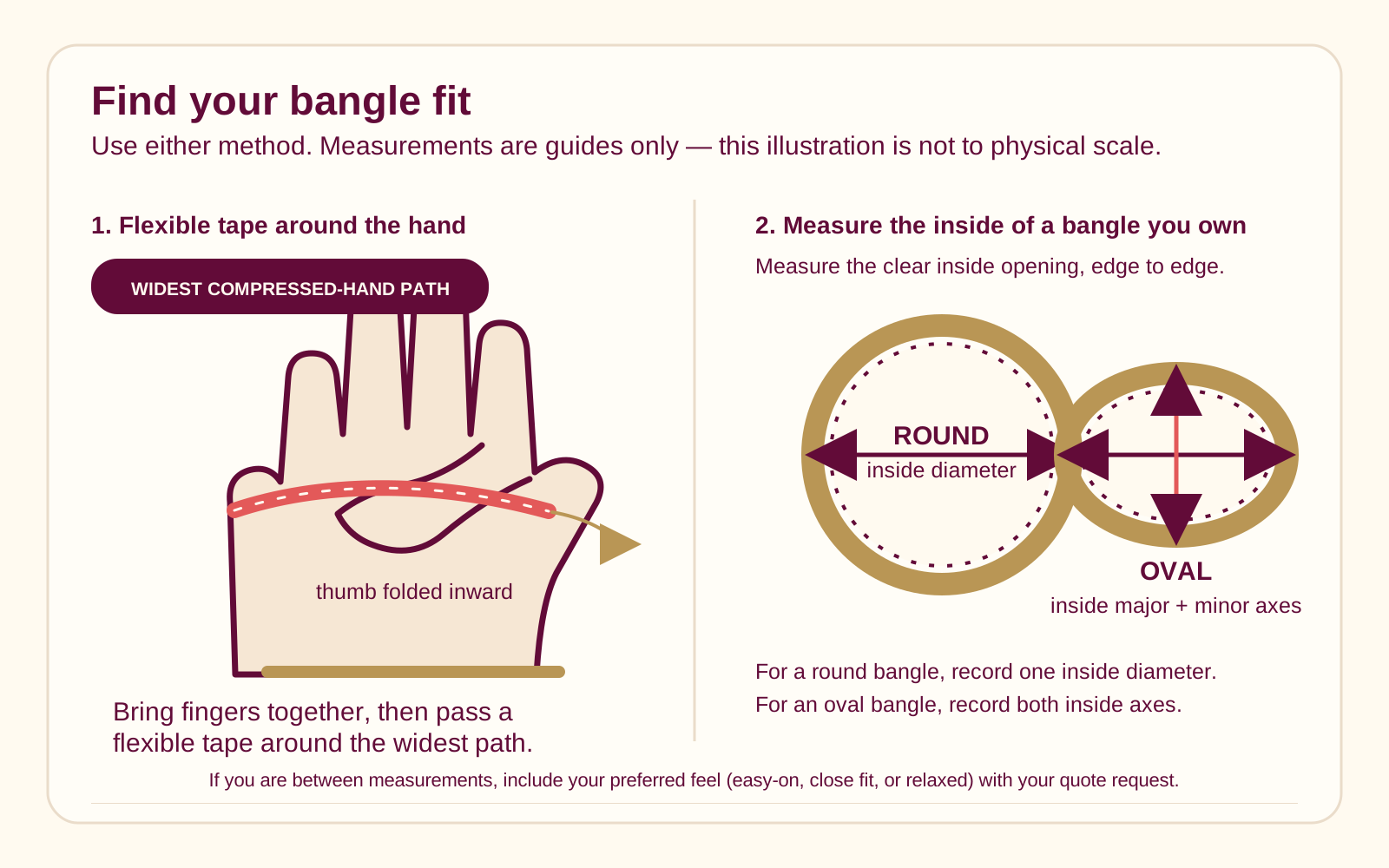
Start with the widest compressed hand path, the inside diameter of a round bangle, or both inside axes of an oval bangle. The calculator keeps that raw value separate from construction and movement so the final fit can be reviewed honestly.
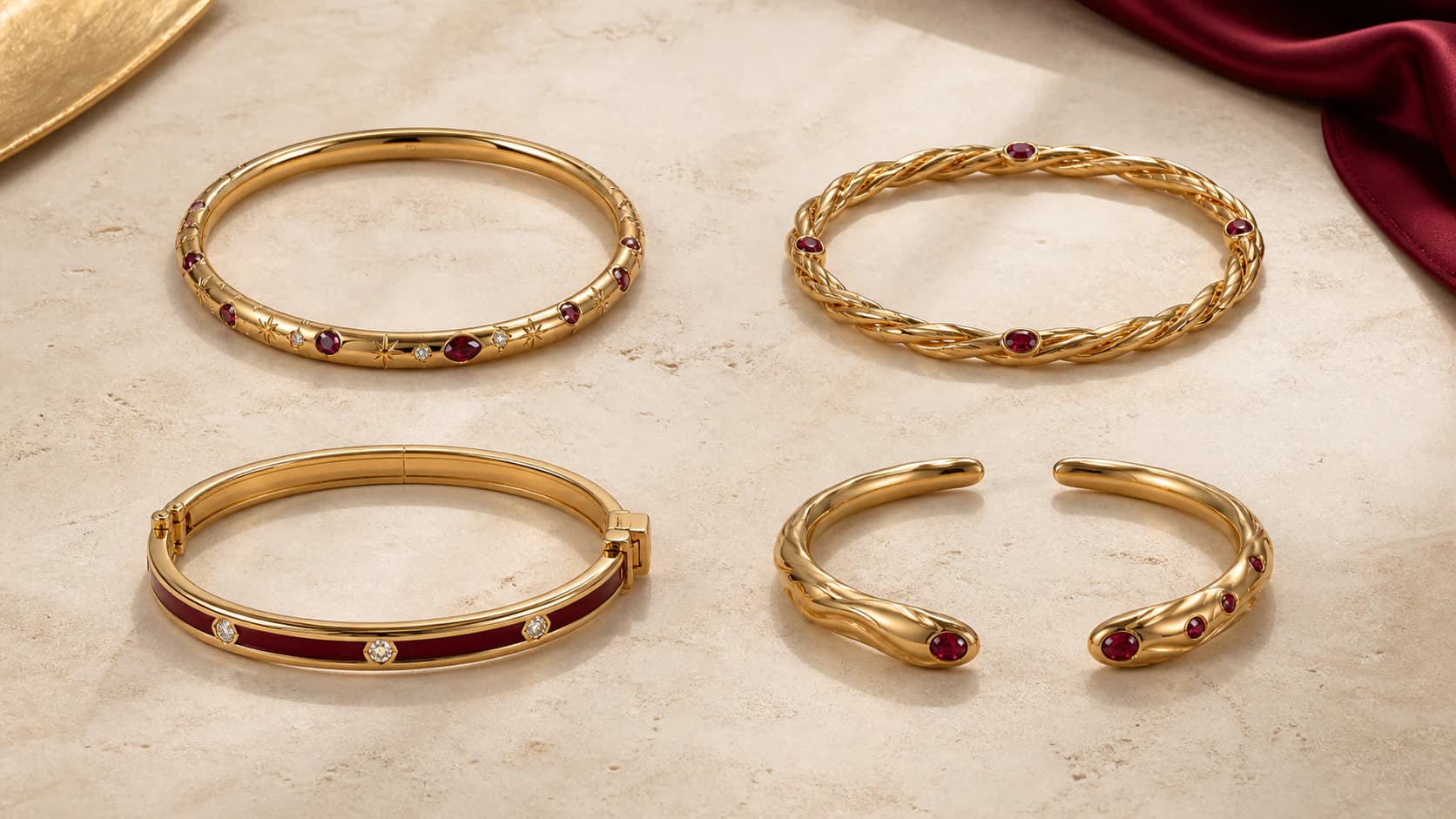
Construction-first bangle calculator
Choose how the piece opens before choosing how to measure.
A closed bangle must pass over the hand. A hinged bangle or cuff opens at the wrist. This tool now reveals only the measurement paths that belong to the construction you choose.Round inside-diameter reference
Compare a measured closed round bangle without turning the row into a wearer-size promise.
These rows mirror the inside-diameter directions available in Leyloon Atelier. They are comparison references, not named wearer sizes, and they do not add a hidden clearance allowance. These rows do not apply to cuffs, hinged pieces, or oval axes.| Inside diameter | Inches | Keep with the value |
|---|---|---|
| 50.8 mm | 2.000 in | Closed round interior · inner edges · exact source unit |
| 54.0 mm | 2.125 in | Closed round interior · inner edges · exact source unit |
| 57.2 mm | 2.250 in | Closed round interior · inner edges · exact source unit |
| 60.3 mm | 2.375 in | Closed round interior · inner edges · exact source unit |
| 63.5 mm | 2.500 in | Closed round interior · inner edges · exact source unit |
| 66.7 mm | 2.625 in | Closed round interior · inner edges · exact source unit |
| 69.9 mm | 2.750 in | Closed round interior · inner edges · exact source unit |
For closed, hinged, and cuff constructions
Choose how it opens. Then measure the path it actually uses.
A closed rigid bangle must pass over the compressed hand. A hinged bangle or cuff opens at the wrist. An existing round or oval piece gives you inside geometry instead. Choose that construction first so the tool never quietly swaps one measurement for another.
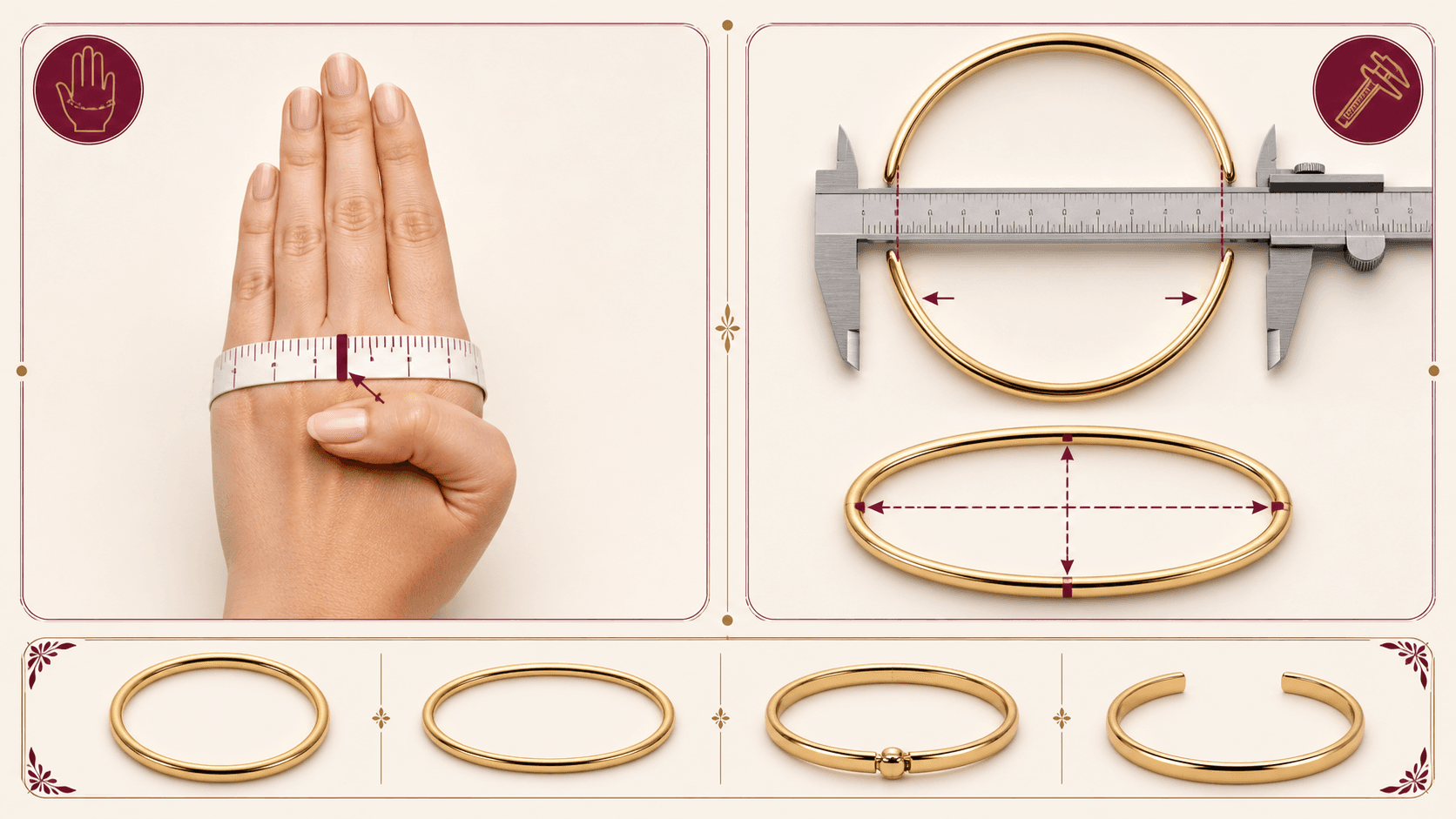
Start with the right question
A small detail can make the whole path clearer.
You are deciding between a closed round, closed oval, hinged, or cuff construction.
You can measure the body path the piece uses, or the empty inside of a piece that already fits.
You have a maker label or no reliable measurement yet and need to keep fit explicitly open.
Use this visual as a clear beginning. Keep the raw measurement, construction, and desired movement separate until the exact design can be reviewed.
A useful comparison
Keep the raw input and the geometry apart
Common market charts are useful starting references. They cannot replace review of the exact shape, width, material, and construction.
| What you have | What it means | What to preserve | Do not assume |
|---|---|---|---|
| Widest-hand path | The bangle’s passage route | Raw circumference and method | It equals wrist size |
| Round inside diameter | Empty inner edge through center | Diameter and construction | Outside metal is equivalent |
| Oval inside axes | Two inner dimensions | Both axes and orientation | One diameter tells the full story |
| Hinged bangle or cuff | An opening construction | Raw wrist, opening, closure, and security | Closed-bangle diameter applies |
What changes the choice
Small details that deserve to stay visible
- Round and oval closed bangles do not share the same inside geometry.
- Width and rigidity can change the clearance a specific design needs.
- A hinged bangle or open cuff begins from wrist and opening context, not a closed-bangle conversion.
Common mix-ups
Easy to avoid once you know them
- Measuring the outside of an existing bangle instead of its empty interior.
- Using wrist circumference for a closed rigid bangle—or a widest-hand shortcut for a cuff.
- Converting a raw hand path into a final size with one universal allowance.
Questions people ask
Take a moment with the part that feels uncertain.
There is no need to guess at a fit detail. Keep the useful clue, then let the next step stay editable.
Why is my wrist measurement not enough?
A closed bangle has to travel over the hand before it rests on the wrist. That hand passage is the important first measurement for a slip-on bangle.
Can I use a bangle that already fits?
Yes. Measure its empty interior from inner edge to inner edge. For an oval, keep both inside axes and its worn orientation rather than reducing it to one label.
What about a hinged bangle or open cuff?
Choose that construction in the calculator. It opens a wrist-based or explicitly open path and keeps closure action, opening, security, width, and movement available for review.
What happens next
Bring the useful clue into a design direction.
- 01
Start with the measurement or construction you know.
- 02
Choose the style and details that matter to you; you can adjust them as you go.
- 03
Explore your direction, then request a quote when you want Leyloon to review the exact piece. Its status and available options stay connected to that request.
A visual map of this brief
See what stays known—and what remains open
This guide begins with “Measure the widest path a closed bangle must pass.” The next choices stay grouped, editable, and connected to that same Atelier brief.
- Inside size or measurement pathKeep the original widest-hand path, inside diameter, oval axes, or cuff opening visible. These are inside measurements, not outside metal dimensions.
- Opening and constructionThis determines whether the piece must pass over the widest hand or open at the wrist.
- Width and cross-sectionChoose the visible body of the bangle separately from inside fit and opening.
- MetalChoose the primary metal direction. Alloy, finish, wear, and exact construction remain reviewable.
Start with what matters on this page
Choose a clear starting direction
Choose what you know now. Every choice remains editable in Atelier, and you can leave anything else open.Already carried from this page
Published customer proof
Real experiences, kept separate from promises
Only approved purchase-linked reviews appear here. An illustrative scene is never presented as a customer, and one person’s experience is never treated as a promise for another piece.See what Leyloon customers have shared
Read recent shop reviews on Etsy, then come back when you are ready to shape your own fit and jewelry direction.
These reviews reflect individual Leyloon service experiences. Your fit and jewelry direction and quote request are reviewed on their own.